
Book of Mormon/Warfare/Swords
|
Criticism
Critics claim that Book of Mormon swords are anachronistic. They claim that no New World swords answering to the Book of Mormon's description have been found, and argue that this counts against the Book of Mormon's historicity.
Source(s) of criticism
- Deanne G. Matheny, "Does the Shoe Fit? A Critique of the Limited Tehuantepec Geography," in Brent Lee Metcalfe (editor), New Approaches to the Book of Mormon: Explorations in Critical Methodology (Salt Lake City, Utah: Signature Book, 1993), 292–97.
- Brent Lee Metcalfe, "Apologetic and Critical Assumptions about Book of Mormon Historicity," Dialogue: A Journal of Mormon Thought 26/3 (Fall 1993): 161 n. 27.
- Search for the Truth DVD (2007) Resources
- Simon Southerton, Losing a Lost Tribe: Native Americans, DNA, and the Mormon Church (Salt Lake City, UT: Signature Books, 2004) 199. ( Index of claims )
Should we expect to find swords?
For an archaeologist to find swords or other weapons in the Old World (the ancient Near East) is very unusual.
As a matter of fact although hundreds of times as much archaeological digging has been done in the Near East as in Mesoamerica, finds of Near Eastern weapons of any type are rarely made. The obvious reason for that is that the kinds of places archaeologists excavate (e.g., temples, elite houses, public buildings) are not where weapons were kept or left anciently.
As a matter of fact, there was little or no reason to intentionally leave a perfectly good weapon anywhere. It would be passed on to another person/warrior, or if left unintentionally it would be salvaged by the first person to find it.
The same would be true in Mesoamerica (where metals were even more rare than in the ancient Near East), or anywhere else.
How we learn the most about weapons in antiquity is from art—if the artist happened to depict a battle scene or armed warriors.
At present, no archaeological evidence for swords of steel (or any other metal) exists in America from Pre-Columbian times. There is now evidence for steel swords in the ancient Near East (something that critics long denied).[1] So, even in the ancient Near East—where the conditions are more suited to preserving artifacts, and much more archaeological work has been done—the identification of steel weapons is recent.
Are all swords made of metal?
The Book of Mormon does indicate that at least some swords were made of metal, specifically, "steel." Some Jaredites are described with steel weapons (see Ether 7:9), and Mosiah 8:11 mentions Limhi's explorers finding the remains of Jaredite battles with blades that have rusted, suggesting that they were metallic.
Nephi1 also acquired an Old World steel sword from Laban (1 Nephi 4:9).
Critics make the unwarranted assumption that because some weapons—generally used by elite leaders—are described as being made of metal, we must therefore conclude that all Book of Mormon swords were made of metal.
In fact, what the Book of Mormon suggests is that some of the elite among the Jaredites and the Nephites had metal swords at certain times, but most swords and armor were not made of metal. Steel swords were exceptional and rare (and, because they were unusual, such weapons were mentioned specifically by the Book of Mormon authors).
Jaredite metallic swords
The earliest reference to steel swords in the Book of Mormon is in a passage recounting the notable deeds of Prince Shule. Shule is described as "mighty in judgment" (Ether 7:8). We are told, "Wherefore, he came to the hill Ephraim, and he did molten out of the hill, and made swords out of steel for those whom he had drawn away with him; and after he had armed them with swords he returned to the city Nehor, and gave battle unto his brother Corihor, by which means he obtained the kingdom" (Ether 7:9). Note here that Shule appears to be the one with the knowledge and skill to do this. "He did molten," he "made swords out of steel," "he . . . armed them." Did he pass this remarkable skill on to others? The passage does not say. It is interesting, however, that the next generation is nearly wiped out (Ether 9:12) and that there is no further mention of steel in the Book of Ether following this episode. Is this an indication that steel technology among the Jaredites was subsequently lost? In periods of social anarchy, valuable possessions tend to be stolen and lost or destroyed. They couldn't keep them (Ether 14:1; Helaman 13:34).
The other passage bearing on the question of Jaredite swords is the one describing King Limhi's search party. Although, they did not find the land of Zarahemla, the search party found ruins of buildings and bones of the Jaredites along with the 24 gold plates of Ether. "And also they have brought breastplates, which are large and they are of brass and of copper, and are perfectly sound. And again they have brought swords, the hilts thereof have perished, and the blades thereof were cankered with rust" (Mosiah 8:10-11). We are not told if the blades were of steel or some other metal which can rust. The search party brought back the plates and the breastplates and the rusted sword blades "for a testimony that the things that they had said are true" (Mosiah 8:9). The fact that they brought the breastplates and rusted sword blades back to Limhi suggests that metal blades and breastplates of copper were rare or unusual.
Nephite metallic swords
After the manner of the sword of Laban...
After separating from the Lamanites, Nephi states, "And I, Nephi, did take the sword of Laban, and after the manner of it did make many swords, lest by any means the people who were now called Lamanites should come upon us and destroy us" (2 Nephi 5:15). Nephi also indicates that he taught his people various skills which included, among other things, working in various metals and some form of steel working (2 Nephi 5:15). One way to read this is that Nephi made other steel swords.
It should be remembered, however, that steel working is a difficult and multifaceted process. Nephi's knowledge of steel may have meant he was skilled enough to make long steel sword blades, or it could simply refer to steel ornamentation. It is interesting to note that Nephi, writing decades after these events, still considered Laban's steel blade to be "most precious" (1 Nephi 4:9). What made Laban's blade "most precious" decades after Nephi made swords for his people? Is this an indication that Nephi's skills with steel, whatever they consisted of fell short of making long steel blades?
Another way to read this is that Nephi made swords after the general pattern of Laban's sword—that is, as a straight shaft with sharp blades along both edges, rather than a one-sided sickle sword which was also common in the ancient near East.[2]
As William J. Hamblin observed:
- The minimalist and tightest reading of this evidence is that Nephi had a steel weapon from the Near East. He attempted to imitate this weapon-whether in function, form, or material is unclear. His descendants apparently abandoned this technology by no later than 400 B.C. Based on a careful reading of the text of the Book of Mormon, there are no grounds for claiming-as anti-Mormons repeatedly do-that the Book of Mormon describes a massive steel industry with thousands of soldiers carrying steel swords in the New World.[3]
Did metal swords persist?
If we suppose that Nephi made other steel swords, need we assume that all subsequent Nephite swords had blades of steel or other metal? To how many Nephites did Nephi pass on the knowledge of working in steel? Did all Nephites know how to work steel or just some? The last reference to steel among the Nephite is during the time of Jarom (Jarom 1:8). After that, steel is never again mentioned among the Nephites. When the Zeniffites return to the land of Nephi a few generations later, they work with iron and other metals, but not steel. This, perhaps not coincidentally, is the last reference to Nephite "iron" (Mosiah 11:3,8).
One has to wonder if some of these early skills were lost. It was apparently an exceptional thing for Nephi or Benjamin to wield the sword of Laban in the defense of their people (Jacob 1:10; W+of+M 1:13). Why would this be necessary for a king if steel technology was commonplace and well-known? This again, suggests that steel swords were the exception not the norm.
One should remember, too, that the "steel" of Joseph Smith's day was not modern steel, and KJV "steel" referred to bronze, not steeled iron. (See FAIR wiki article on metals, especially steel.)
Historical parallels
By way of historical analogy, in many rural villages in places such as Asia or Africa, one family of artisans might supply the metallurgical needs of thousands, yet the ferrous skills possessed by those few could easily be lost in just one raid. It seems reasonable to suggest that a similar situation occurred among the early Jaredites and Nephites in ancient Mesoamerica.
In a recent study of North American copper pan pipes, one scholar attempted to explain why certain copper technologies, if once available in North American Middle Woodland cultures, were not passed down to subsequent groups. She reasoned, "The technological information must have been restricted to a limited number of individuals and artisans. Following the disruption of the interaction sphere, this information in the hands of so few artificers and entrepreneurs was not passed on and was consequently lost. There was no retention of that knowledge and when, half a millennium later new societies developed, it was with new copper techniques and new artifact styles."[4]
In the absence of archaeological evidence for metal weapons in early Mesoamerican times, it is worth remembering that there is linguistic evidence, noted by John Sorenson, for metals in Mesoamerican antiquity dating back to Olmec times.[5] When this is coupled with the interpretation of the rarity of metals swords mentioned above, the issue is much less problematic when additional perspective is added.
Were there swords in Pre-Columbian America?
Some critics have charged that no Pre-Columbian swords existed at all. This is clearly false; evidence from Pre-Columbian art supports the idea that there were swords as early as the Pre-classic.[6] Non-LDS authors have often used the term "sword" for such weapons.[7]
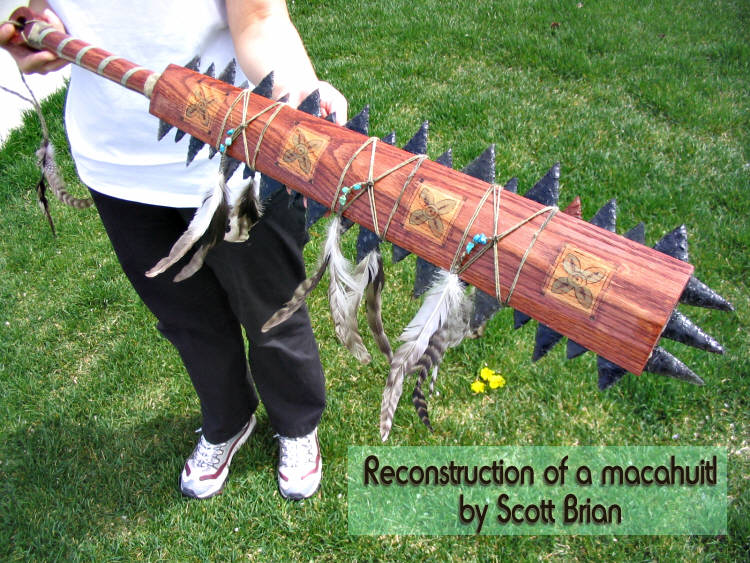
Scott Brian, a graduate student of Archaeology at BYU, has made several reconstructions of a macuahuitl, the ancient Mesoamerican weapon often termed a "sword"—the term the Spaniards used when they faced this fearsome weapon that could cut better than metal swords.
See photos of the modern reconstruction: Photo 1 Photo 2 Photo 3
One chronicle described the macuahuitl's ability to decapitate a horse:
- While we were at grips with this great army and their dreadful broadswords, many of the most powerful among the enemy seem to have decided to capture a horse. They began with a furious attack, and laid hands on a good mare well trained both for sport and battle. Her rider, Pedro de Moron, was a fine horseman; and as he charged with three other horsemen into enemy ranks—they had been instructed to charge together for mutual support—some of them seized his lance so that he could not use it, and others slashed at him with their broadswords, wounding him severely, Then they slashed at his mare, cutting her head at the neck so that it only hung by the skin. The mare fell dead, and if his mounted comrades had not come to Moron's rescue, he would probably have been killed also.(italics added)[8]
Book of Mormon examples
Some Book of Mormon passages make less sense if the reference to "sword" is read as a European-style, metallic sword.
For example, the Anti-Nephi-Lehi group described how the atonement of Christ had miraculous made their swords "bright" again, after being stained with the blood of murder:
- And now behold, my brethren, since it has been all that we could do, (as we were the most lost of all mankind) to repent of all our sins and the many murders which we have committed, and to get God to take them away from our hearts, for it was all we could do to repent sufficiently before God that he would take away our stain—Now, my best beloved brethren, since God hath taken away our stains, and our swords have become bright, then let us stain our swords no more with the blood of our brethren. Behold, I say unto you, Nay, let us retain our swords that they be not stained with the blood of our brethren; for perhaps, if we should stain our swords again they can no more be washed bright through the blood of the Son of our great God, which shall be shed for the atonement of our sins.(Alma 24:11-13)
Wiping blood from a metal blade is simple—cleaning such a weapon is no miracle. However, the wooden-hafted macuhuitl would absorb the blood, making it almost impossible to clean. The "brightness" of the sword blades matches well with obsidian fragments. Obsidian was polished into mirrors, and gleamed brightly. The Spaniard Torquemada described obsidian as
- a stone which might be called precious, more beautiful and brilliant than alabaster or jasper, so much so that of it are made tablets and mirrors...[9]
For other photos of how shiny obsidian can be here: Image 1, Image 2, Image 3
Summary conclusion
- Metal swords are rare in the Book of Mormon, and so likely to be rare in the archaeological record.
- Few weapons of any kind have been found in archaeological digs from the Old World; lack of investigation and a more challenging environment make it unsurprising that metallic weapons have yet to be found in Mesoamerica. The critics' argument is merely from silence in this case.
- Swords clearly existed in Mesoamerica, and they were so labeled by Spanish conquistadors.
- Some descriptions of Nephite/Lamanite swords make more sense if a non-metallic sword such as a macahuitl is indicated by the text.
In short, critics have not taken the time to understand the Book of Mormon text and the Pre-Columbian context from which it springs. They read the text in the most naive fashion possible, and so dismiss it unfairly.
Endnotes
- [note] Anonymous, "Out of the Dust: Ancient Steel Sword Unearthed," Journal of Book of Mormon Studies 14/2 (2005): 64–64. off-site PDF link wiki
- [note] Yigael Yadin, The Art of Warfare in Biblical Lands 1:10—11.
- [note] William J. Hamblin, "Steel in the Book of Mormon," FAIR link
- [note] Claire G. Goodman, Copper Artifacts in Late Eastern Woodlands Prehistory, edited by Anne-Marie Cantwell, (Evanston, Illinois: Northwestern University Center for American Archaeology, 1984), 73.
- [note] John L. Sorenson, An Ancient American Setting for the Book of Mormon (Salt Lake City, Utah : Deseret Book Co. ; Provo, Utah : Foundation for Ancient Research and Mormon Studies, 1996 [1985]),279–280. ISBN 1573451576. GospeLink (requires subscrip.)GL direct link
- [note] Matthew Roper, "Swords and "Cimeters" in the Book of Mormon," Journal of Book of Mormon Studies 8/1 (1999): 34–43. off-site [No PDF link] wiki
- [note] Diego Durán, The History of the Indies of New Spain, trans. Doris Heyden (Norman: University of Oklahoma Press, 1994), 66, 76, 109, 135, 139, 150, 152–53, 171, 198, 279, 294, 323, 375, 378, 412, 428, 437, 441, 451, 519, 552–53; Diego Durán, Book of the Gods and Rites and the Ancient Calendar, trans. Doris Heyden and Fernando Horcasitas (Norman: University of Oklahoma Press, 1971), 124, 178–80, 234, 236; The macuahuitl "was equivalent to the sword of the Old Continent"; Francesco S. Clavijero, The History of Mexico, trans. Charles Cullen, 3 vols. (Philadelphia: Budd and Bartram, 1804), 2:165. Cited in Matthew Roper, "Eyewitness Descriptions of Mesoamerican Swords," Journal of Book of Mormon Studies 5/1 (1996): 150–158. off-site PDF link wiki See footnotes 4-5.
- [note] Over a dozen examples are cited in Matthew Roper, "Eyewitness Descriptions of Mesoamerican Swords," Journal of Book of Mormon Studies 5/1 (1996): 150–158. off-site PDF link wiki This example comes from Bernal Diaz, The Conquest of New Spain, trans. J. M. Cohen (New York: Penguin Books, 1963), 145.
- [note] P. Marcou, "Procédé des Aztèques pour la taille par éclatement des couteaux ou rasoirs d'obsidienne," trans. by Edward B. Tylor [check spelling], Journal de la Société des Americanistas de Paris 13 (1921): 19; cited in Matthew Roper, "On Cynics and Swords (Review of Of Cities and Swords: The Impossible Task of Mormon Apologetics)," FARMS Review of Books 9/1 (1997): 146–158. off-site PDF link
Further reading
FAIR wiki articles
Book of Mormon: Claimed anachronisms
Animals
- Animals—
Critics claim that the Book of Mormon mentions animals which do not belong in a pre-Columbian New World. They cite this as evidence for Joseph Smith 'slipping up,' and revealing his forgery. Often attacked examples include: the ass (donkey), bees, the cow, the elephant, the horse, silkworms, and swine (pigs). Some sport is also had at the expense of two unknown animals, which are given untranslated names cureloms and cumoms (Link)- Jaredites added to explain New World animals—Critics charge the the story of the Jaredites, as described in the Book of Ether, was added by Joseph Smith as an "afterthought" in order to account for the variety of animals present in the New World at the time of arrival of Lehi's group. Critics suggest that the Book of Ether was simply an "afterthought" added by Joseph Smith to the Book of Mormon in order to explain the presence of a wide variety of animals in the New World at the time of the arrival of Lehi's party. (Link)
- Serpents and drought (Link)
Biblical
Claimed anachronisms and other KJV text issues in the Book of Mormon
- Malachi text in the Book of Mormon—
Critics claim that the Book of Mormon cannot be an ancient work because it quotes Malachi hundreds of years before Malachi was written (i.e, they claim that Mal. 4:1 is quoted in 1 Nephi 22:15). However, the Book of Mormon claims to be a "translation." Therefore, the language used is that of Joseph Smith. Joseph could choose to render similar (or identical) material using King James Bible language if that adequately represented the text's intent. The translation language may resemble Malachi, but the work is not attributed to Malachi. Only if one presumes that the Book of Mormon is a fraud at the outset is this proof of anything. If one accepts that it is a translation, then the use of Bible language tells us merely that Joseph used biblical language. (Link) - New Testament text?—
Critics claim that the Book of Mormon cannot be an ancient work because it contains material that is also found in the New Testament. In the Book of Mormon, Jesus quotes a paraphrase of Moses' words found in Acts 3:22-26. (Link) - Deutero-Isaiah—
The "Deutero-Isaiah" theory is the claim that parts of Isaiah were written later than others. This theory claims that there were three individual authors, whose works were later compiled together under the name of the first author Isaiah (referred to as "Proto Isaiah"). The critical issue raised is that the Brass Plates of Laban quote from sections of Isaiah that this theory ascribes to Deutero-Isaiah, so how could the Nephites have these writings if they weren't written until after they left Jerusalem? (Link) - Firstling sacrifices—
Critics claim that the Book of Mormon report that Nephites offered burnt offerings of the firstlings of their flocks is not consistent with Jewish law or practice. While firstlings were not used for every sacrifice, they certainly did have a role in the sacrificial practices of Israel. The critics have misunderstood the Bible on this point. (Link) - Holy Ghost—
Why is the Holy Ghost mentioned so many times in the Book of Mormon prior to the time of Christ (e.g., 1 Nephi 10:17) and yet in the Old Testament there is hardly any mention of the Holy Ghost, especially with regard to his mission of bearing witness of the truth? (Link) - Jeremiah in prison—
Critics claim that Nephi's mention of Jeremiah being put into prison (1 Nephi 7:14) is anachronistic, since Jeremiah would not have been in prison when Lehi left Jerusalem. (Link) - Jerusalem as site of Jesus' birth—
Critics point out that Alma 7:10 says that Jesus would be born "at Jerusalem which is the land of our forefathers." Yet, every schoolchild knows that Jesus was born in Bethlehem. They claim that this is a mistake, and evidence that Joseph Smith forged the Book of Mormon. However, it is important to note what Alma's words were. He did not claim Jesus would be born in the city of Jerusalem, but "at Jerusalem which is the land of our forefathers." Bethlehem is located only five miles from Jerusalem. Thus, the Book of Mormon makes a distinction here between a city and the land associated with a city. (Link) - Josephites and Jerusalem—
Critics claims that the fact that Lehi was not of Judah, but of the tribe of Joseph, makes it absurd for him to have been living in Jerusalem before the Babylonian captivity: "The tribe of Joseph at Jerusalem! Go, study scripture-geography, ye ignorant fellows, before you send out another imposition, and make no more such foolish blunders." (Link) [needs work] - Book of Mormon plagiarized from Bible? (Link)
- Mainly altered italics in the KJV?—
Critics claim that in the Book of Mormon material which parallels the KJV, Joseph Smith generally modified the italicized text. (Link) - Book of Mormon "translation errors" from KJV?—
Critics wonder why many of the quotes from Isaiah in the Book of Mormon are identical to the King James version. The Book of Mormon incorporates text which seems to be taken from the King James Version, including passages which are now considered to be mistranslations in the King James Version. If the Book of Mormon is an accurate translation, critics claim that it shouldn't contain these translational errors. (Link) - Book of Mormon translation (Link)
- Book of Mormon and the Dead Sea Scrolls (Link)
Climate
Culture
- Calendar—
The Book of Mormon calendar is not identical to the calendar used by modern peoples. Learn about Nephite calendar(s) here. (Link)- Was the idea of a "week" unknown in the Americas?—Despite claims to the contrary, there is evidence for a seven-day week among the early Maya, though the Book of Mormon does not require such a correlation. (Link)
- Olive culture (Link)
- Legal codes and concepts (Link)
DNA
- DNA issues—
DNA samples taken from modern Native Americans do not match the DNA of modern inhabitants of the Middle East. Critics argue that this means the Book of Mormon's claim that Native Americans are descended from Lehi must be false, and therefore the Book of Mormon is not an ancient record as Joseph Smith claimed. Few criticisms of the Church have received as much media attention as this criticism, with so little thought and science being applied to the question. DNA attacks against the Book of Mormon account fail on numerous grounds. (Link)
Doctrine
- Modalism—
Critics claim that the Book of Mormon teaches the trinitarian heresy of modalism or Sabellianism. This reading misinterprets some Book of Mormon verses, and ignores Book of Mormon texts which clearly contradict this reading. (Link) - Pre-Christian Christianity—
Critics claim that it is an anachronism that the Book of Mormon teaches that Christians existed before Christ’s birth. (Link) - Temple in the New World—
Critics attack the presence of an Israelite temple built by the Nephites. They do so on one or more of the following grounds: 1) They claim that Israelites considered the Jerusalem temple the sole legitimate site of worship, and so would not have reproduced it. 2) They claim that the Nephite population would have been too small to match the work required to built a temple "like unto Solomon's temple" (2 Nephi 5:16). 3) They claim that the temple built was "similar in splendor" to Solomon's temple. 4) They claim that the sacrifices and rituals as presented are not consistent with Jewish ritual. (Link) - Two natures of Christ (Link)
Events
Geography
- Bethabara—
Alexander Campbell, an early Book of Mormon critic, complained that the Book of Mormon "makes John [the Baptist] baptize in the village of Bethabara." The Book of Mormon, however, uses the same term as the King James Bible: "These things were done in Bethabara beyond Jordan, where John was baptizing." (John 1:28) (Link) - River runs into a fountain (Link) [needs work]
Government
- Democracy—
Critics claims that the fact that the Nephite reign of the judges is a thinly-disguised version of nineteenth-century American republicanism. (Link) [needs work] - Legal codes and concepts—
Do the legal concepts in the Book of Mormon better match Joseph Smith's day, or the ancient world? (Link) - Republicanism (Link)
Items
- Chariots—
Critics claim that the Book of Mormon mentions "chariots" which they claim must be a "wheeled vehicle." They also note that no draft animals existed to pull such chariots. 3 Nephi 3:22 notes that the Nephites "had taken their horses, and their chariots" to a central fortified area for protection against robbers. It should be noted that we are not told if these chariots served a purpose in riding, or if they were for transport of goods, or if they had a ceremonial function. One assumes some sort of practicality or ritual importance in war, since they brought chariots to the siege. Conspicuously absent is any role of the chariot in the many journeys recorded in the Book of Mormon. Nor do horses or chariots play any role in the many Nephite wars; this is in stark contrast to the Biblical account, in which the chariots of Egypt, Babylon, and the Philistines are feared super-weapons upon the plains of Israel. (Link) - Coins—
Critics claim that Book of Mormon references to Nephite coins is an anachronism, as coins were not used either in ancient America or Israel during Lehi's day. However, the word "coins" was only added to the chapter heading of Alma 11 much later, and the text of the Book of Mormon itself does not mention coins. The pieces of gold and silver described in Alma 11:1-20 are not coins, but a surprisingly sophisticated system of weights and measures that is entirely consistent with Mesoamerican proto-monetary practices. (Link) - Compass—
Critics charge that the description of the Liahona as a "compass" is anachronistic because the magnetic compass was not known in 600 B.C. However, believing it was called a compass because it pointed the direction for Lehi to travel is the fault of the modern reader, not the Book of Mormon. As a verb, the word "compass" occurs frequently in the King James Version of the Bible; and it generally suggests the idea of surrounding or encircling something (Link) - "Gold" plates?—
Critics claim that Joseph Smith, Jr. manufactured some metal plates out of tin, copper, or some other metal in order to trick witnesses into thinking he had gold plates. Gold plates of the dimensions described by the witnesses would be too heavy (on the order of 200 lbs) to be realistically lifted and carried as Joseph and others described. This assumption, however, assumes a solid block of gold in the dimensions described, and does not account for the fact that pure gold would have been too fragile to form the thin leaves necessary for engraving. (Link)- Plates too heavy for Joseph to run with—How heavy were the plates? Could Joseph have run with them as described despite his boyhood operation? (Link)
- Gunpowder!—
Some critics claim that the Book of Mormon mentions "gunpowder," and "pistols and other firearms," which are clearly anachronisms. The claim is false. There is no mention of "gunpowder" or firearms, or anything like them, in the Book of Mormon. (Link) - Temple in the New World—
Critics claim that Israelites would not have built a temple in the New World outside of Jerusalem. This ignores Israelite temples built in the Old World outside Jerusalem. (Link) - Windows—
Critics claim that the mention of "windows" implies the existence of glass in Book of Mormon times. (Link)
Language
- Language—
Claimed anachronisms related to language used in the Book of Mormon. (Link)- "Adieu"—Jacob 7:27 ends with the phrase, "Brethren, adieu." Critics claim that because adieu is French, it shows that Joseph Smith composed the Book of Mormon, and not an ancient author. There are at least three problems with the adieu argument against the Book of Mormon. 1) Critics overlook the fact that the word adieu was not on the plates. 2) The translator of a work can use words from any language he chooses in order to convey the meaning of the text to his readers, so that even if "adieu" had been a foreign word (e.g., French) to Joseph Smith, there is nothing either unusual or problematic with his choosing that word in his translation. 3) Critics mistakenly think the word "adieu" is not used as an English word. (Link)
- And it came to pass—Critics have often complained about the frequent repetition of "and it came to pass" in the Book of Mormon.[1] Mark Twain famously joked that if the phrase were omitted, Joseph would have published a pamphlet instead of a book. As it turns out, however, this much-maligned phrase is actually evidence of the Book of Mormon's authentic antiquity. (Link) [needs work]
- Greek words: alpha and omega?—Critics claim that the Book of Mormon cannot be an ancient work because it contains "Greek words" ("alpha and omega"). However, the Book of Mormon claims to be a translation. Therefore, the language used is that of Joseph Smith. Joseph could choose to render similar (or identical) material using King James Bible language if that adequately represented the text's intent. (Link)
- Modern phrasing—Critics maintain that Book of Mormon phrases or language is too "modern" to be of ancient origin. The Book of Mormon is a translation. As such, it may well use phrases or expressions that have no exact ancient counterpart. Modern Bible translations use similar expressions or phrases, and yet remain translations of ancient documents. (Link)
- Hebrew and Native American languages—Is there any evidence that Old World languages (such as Hebrew) had an influence on the languages of the New World? Critics claim that the Book of Mormon provides too short a time for the disappearance of the Nephite/Lamanite Hebrew language. (Link)
- Red Sea vs Reed Sea—Critics cast doubt on Moses' miraculous parting of the Red Sea by asserting that this belief arose due to a mistranslation of the Hebrew phrase yam sûp. The critics argue that the phrase should read "the Reed Sea," and that the Israelites actually just crossed a marshy inlet while the Egyptians' chariots got stuck in the mud. Having "proved" that the popular understanding of the KJV is inaccurate, the critics then conclude that the Book of Mormon's use of "Red Sea" is evidence that Joseph was not producing an inspired translation, but simply copying from the (mistaken) King James text. (Link)
- Reformed Egyptian—Critics claim that Jews or Israelites (like the Nephites) would not have used the language of their slave period — Egyptian — to write sacred records, that there is no evidence in Egyptology of something called "reformed Egyptian," and that the Book of Mormon's claim to have been written in this language is therefore suspect. However, the claim that Israelites would not use Egyptian is clearly false. By the ninth to sixth centuries before Christ, Israelites used Egyptian numerals mingled with Hebrew text. The Papyrus Amherst 63 contains a text of Psalms 20:2-6 written in Aramaic (the language of Jesus) using Egyptian characters. This text was originally dated to the second century B.C., but this has since been extended to the 4th century B.C. (Link)
- Egyptian would not be shorter than Hebrew on the plates—Critics claim that Egyptian would be too lengthy and bulky on the plates to account for the Book of Mormon [Egyptian would take] "perhaps four times, or even more than four times, as much room as the English, and it is quite certain that, as the Book of Mormon is 600 pages thick, it would take at least a thousand plates to hold in the Egyptian language, what is there written." (Link)
- Names—
Critics claim some Book of Mormon names are used improperly or in an inappropriate context. Examples include using "Alma" as a man's name, rather than a woman's name and using names of Greek origin, such as "Timothy" (Link)- Comoros Islands and Moroni—Comoros is a small nation made up of three islands off the southeast coast of Africa. Its capital city is Moroni. Some critics have claimed that Joseph Smith created the Book of Mormon names Cumorah and Moroni by copying them from a map of the Comoros islands. (Link)
- Synagogues (Link)
Masonry
- Gadianton Robbers as Masons?—
Critics claim that the Gadianton robbers are thinly disguised references to the anti-Masonic panic of Joseph Smith's era. Joseph's contemporaries did not embrace the "obvious" link between the Book of Mormon and masonry. Proponents or opponents of Masonry simply tended to blame their opponents for Mormonism. Given Joseph Smith's long family involvement with the institution of Freemasonry and the fact that he would, in 1842, become a Mason himself, it seems unlikely that anti-Masonry was the "environmental source" of the Gadianton robbers found in the Book of Mormon. The members of his day likewise had little enthusiasm for anti-Masonic sentiments. (Link)
Materials
- Cement—
Critics claim that the Nephites in the land northward building out of cement in Helaman 3:7-11 (circa 47 B.C.) is not valid. As critic John L. Smith put the claim, "There is zero archaeological evidence that any kind of cement existed in the Americas prior to modern times" (John L. Smith, "What about those Gold Plates?" The Utah Evangel 33:6 (September 1986): 8.) In this case, however, an attack on an 'absence of evidence' backfired. Cement is not anachronistic. The Book of Mormon places it in exactly the right spot and time period for Mesoamerican use of this building material. (Link) - Metals—
Critics attack the Book of Mormon's mention of metal and metalworking in the Americas: 1) they claim no metal use occurred in the Americas prior to A.D. 900, and 2)they claim certain metals mentioned in the Book of Mormon were not available in the Americas. (Link) - Metal Plates (Link)
Plants
- Plants—
Critics claim that plants mentioned in the Book of Mormon are not found in the New World, and are thus evidence that Joseph fabricated the text based upon his own cultural background. (Link)
Population
- Demographics—
Critics charge that the initial Lehite colony is too small to produce the population sizes indicated, and that Lehi's group was sent to a land which was kept from the knowledge of other nations, therefore, according to the Book of Mormon, there could not have been "others" present. A superficial reading of the Book of Mormon leads some to conclude that the named members of Lehi's group were the only members of Nephite/Lamanite society. However, the Book of Mormon contains many mentions of "others" that made up part of both societies; indeed, many Book of Mormon passages make little sense unless we understand this. (Link)
Science
Text
- Chapter divisions—
Critics claims that the fact that the Book of Mormon has chapters demonstrate that it is a modern production. The table of contents was a modern insertion; it had no counterpart in the dictated text of the Book of Mormon. It was added just as it is in modern Bibles. However, the first edition of the Book of Mormon did contain chapters (though much longer than the modern chapters), and chapter markers were part of Joseph's dictated text. (Link)
Warfare and weapons
FAIR web site
- FAIR Topical Guide: Weapons and Warfare in Book of Mormon FAIR link
External links
- William J. Adams Jr., "Nephi's Jerusalem and Laban's Sword," Journal of Book of Mormon Studies 2/2 (1993): 194–195. off-site PDF link wiki
- Anonymous, "Near Eastern Weapon Parallels," Journal of Book of Mormon Studies 8/1 (1999): 39–40. off-site [No PDF link] wiki
- Anonymous, "Out of the Dust: Ancient Steel Sword Unearthed," Journal of Book of Mormon Studies 14/2 (2005): 64–64. off-site PDF link wiki
- William J. Hamblin, "An Apologist for the Critics: Brent Lee Metcalfe's Assumptions and Methodologies (Review of Apologetic and Critical Assumptions about Book of Mormon Historicity by Brent Lee Metcalfe)," FARMS Review of Books 6/1 (1994): 434–523. off-site PDF link (see pages 481-483).
- Brett L. Holbrook, "The Sword of Laban as a Symbol of Divine Authority and Kingship," Journal of Book of Mormon Studies 2/1 (1993): 39–72. off-site PDF link wiki
- Daniel N. Rolph, "Prophets, Kings, and Swords: The Sword of Laban and Its Possible Pre-Laban Origin," Journal of Book of Mormon Studies 2/1 (1993): 73–79. off-site PDF link wiki
- Matthew Roper, "Eyewitness Descriptions of Mesoamerican Swords," Journal of Book of Mormon Studies 5/1 (1996): 150–158. off-site PDF link wiki
- Matthew Roper, "On Cynics and Swords (Review of Of Cities and Swords: The Impossible Task of Mormon Apologetics)," FARMS Review of Books 9/1 (1997): 146–158. off-site PDF link
- Matthew Roper, "Swords and "Cimeters" in the Book of Mormon," Journal of Book of Mormon Studies 8/1 (1999): 34–43. off-site [No PDF link] wiki
- John L. Sorenson, "Viva Zapato! Hurray for the Shoe! (Review of "Does the Shoe Fit? A Critique of the Limited Tehuantepec Geography" by Deanne G. Matheny," FARMS Review of Books 6/1 (1994): 297–361. off-site PDF linkGL direct link (see pages 324-331).
Printed material
- William J. Hamblin and A. Brent Merrill, "Swords in the Book of Mormon," in Ricks and Hamblin, eds., Warfare in the Book of Mormon (Salt Lake City: Deseret Book and FARMS, 1990), 329–351.
- John L. Sorenson, An Ancient American Setting for the Book of Mormon (Salt Lake City, Utah : Deseret Book Co. ; Provo, Utah : Foundation for Ancient Research and Mormon Studies, 1996 [1985]),262–263. ISBN 1573451576. GospeLink (requires subscrip.)

