Articles about the Book of Mormon
Authorship |
|
Translation process |
|
Gold plates |
|
Witnesses |
|
The Bible and the Book of Mormon |
|
Language and the Book of Mormon |
|
Geography |
|
DNA |
|
Anachronisms |
|
Doctrine and teachings |
|
Lamanites |
|
Other |
|
Metal plates in ancient Israel
Video from The Interpreter Foundation.
Question: Is Joseph Smith's report of finding an ancient record on inscribed on metal plates plausible?
There are numerous examples of ancient writing on metal plates
When it first appeared, the Book of Mormon was attacked for the alleged absurdity of having been written on golden plates and its claim of the existence of an early sixth century B.C. version of the Hebrew Bible written on brass plates. Today, however, there are numerous examples of ancient writing on metal plates. Ironically, some now claim instead that knowledge of such plates was readily available in Joseph Smith's day. Hugh Nibley's 1952 observation seems quite prescient: "it will not be long before men forget that in Joseph Smith's day the prophet was mocked and derided for his description of the plates more than anything else." [1]
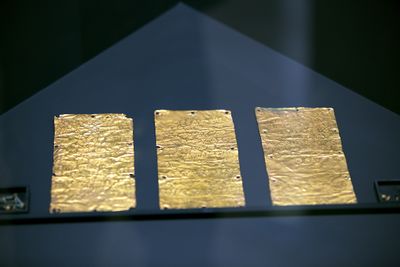
Pyrgi gold plates. Photo (C) 2014, William J. Hamblin, used with permission. These plates are religious texts dating to around 500 BC in Italy; one is written in Phoenician (= Paleo-Hebrew), and two in Etruscan. They are now in the Etruscan Museum in the Villa Giulia in Rome. The Phoenician text is in the middle. (Click to enlarge)
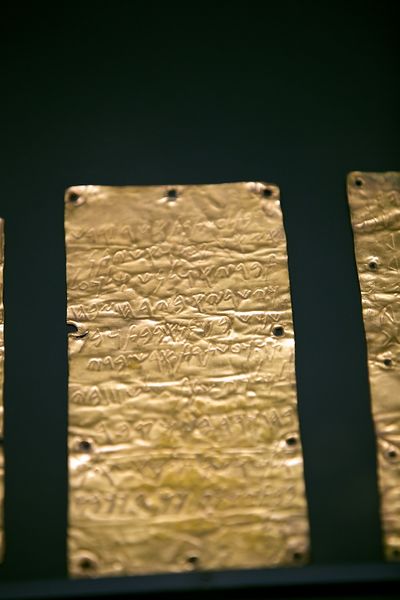
Pyrgi gold plates. Photo (C) 2014, William J. Hamblin, used with permission. This is a close-up of the middle plate (in Phoenician/Paleo-Hebrew). (Click to enlarge)
The Book of Mormon's description of sacred records written on bronze plates fits quite nicely in the cultural milieu of the ancient eastern Mediterranean
Recent reevaluation of the evidence now points to the fact that the Book of Mormon's description of sacred records written on bronze plates fits quite nicely in the cultural milieu of the ancient eastern Mediterranean.
One of the earliest known surviving examples of writing on "copper plates" are the Byblos Syllabic inscriptions (eighteenth century B.C.), from the city of Byblos on the Phoenician coast. The script is described as a "syllabary [which] is clearly inspired by the Egyptian hieroglyphic system, and in fact is the most important link known between the hieroglyphs and the Canaanite alphabet."[2]
It would not be unreasonable to describe the Byblos Syllabic texts as eighteenth century B.C. Semitic "bronze plates" written in "reformed Egyptian characters."[3]
Walter Burkert, in his study of the cultural dependence of Greek civilization on the ancient Near East, refers to the transmission of the practice of writing on bronze plates (Semitic root dlt) from the Phoenicians to the Greeks. "The reference to 'bronze deltoi [plates, from dlt ]' as a term [among the Greeks] for ancient sacral laws would point back to the seventh or sixth century [B.C.]" as the period in which the terminology and the practice of writing on bronze plates was transmitted from the Phoenicians to the Greeks.[4]
Students of the Book of Mormon will note that this is precisely the time and place in which the Book of Mormon claims that there existed similar bronze plates which contained the "ancient sacred laws" of the Hebrews, the close cultural cousins of the Phoenicians.
Burkert also maintains that "the practice of the subscriptio in particular connects the layout of later Greek books with cuneiform practice, the indication of the name of the writer/author and the title of the book right at the end, after the last line of the text; this is a detailed and exclusive correspondence which proves that Greek literary practice is ultimately dependent upon Mesopotamia. It is necessary to postulate that Aramaic leather scrolls formed the connecting link."[5]
It would be counterintuitive in the 19th century to place the "title page" at the end of the book, yet this was an authentic ancient practice
Joseph Smith wrote that "the title page of the Book of Mormon is a literal translation, taken from the very last leaf, on the left hand side of the collection or book of plates, which contained the record which has been translated."[6]
This idea would have been counterintuitive in the early nineteenth century when "Title Pages" appeared at the beginning, not the end, of books.
Why, then, did Joseph claim the Book of Mormon practiced subscriptio—writing the name of the author and title at the end of the book? If the existence of the practice of subscriptio among the Greeks represents "a detailed and exclusive correspondence which proves that Greek literary practice is ultimately dependent upon Mesopotamia [via Syria]," as Burkert claims, cannot the same thing be said of the Book of Mormon—that the practice of subscriptio represents "a detailed and exclusive correspondence" which offers proof that the Book of Mormon is "ultimately dependent" on the ancient Near East?
William J. Adams Jr. (1994): "These incidences raise the question: Did others in Lehi's Jerusalem inscribe records on metal plates?"
William J. Adams Jr.,
Lehi sent his sons back to Jerusalem to obtain scriptures engraved on "brass plates" (1 Nephi 3 and 4). Later we read that Lehi and his son, Nephi, kept records on metal "plates" (1 Nephi 6 and 9). These incidences raise the question: Did others in Lehi's Jerusalem inscribe records on metal plates?
The use of metal plates upon which records are inscribed is fairly well attested throughout the Middle and Far East from many centuries before to many centuries after Lehi, but none so far appear to be from Lehi's seventh-century BC Judea.
This lack of metal inscriptions from Judea could be interpreted to mean that (1) Judeans did not write on metal plates, or (2) archaeology has not found artifacts which would support the practice of writing on metal plates in seventh-century BC Jerusalem. Alternative 2 seems to have been the problem, for inscribed silver plates have been excavated only recently.[7]
Sidney B. Sperry (1995): "Questions arise as to how Jeremiah's prophecies appeared on the brass plates"
Sidney B. Sperry,
Most contemporary Old Testament scholars question whether Moses wrote the Pentateuch, but the Book of Mormon affirms Moses' authorship. Questions arise as to how Jeremiah's prophecies appeared on the brass plates and what the nature of the Book of the Law was. According to the brass plates Laban and Lehi were descendants of Manasseh. How then did they come to be living in Jerusalem? The brass plates, on which may be found lost scripture, may have been the official scripture of the ten tribes.[8]
Question: What examples exist of writing on gold or other metal plates from around the ancient world?
Majority of references in this section courtesy of researcher Ted Jones.
Burma
- gold plate in Burma, 6th century AD[9]
China
- King of Wu found a writing on golden tablets but could not read it. He sent it to Confucius. It was a text of Ling Pao, given by Celestial Officials to the early sage. It dealt with the method of obtaining a long life.[10]
- An example from China circa 300 BC:
- "How do we know that the former sage Six Kings personally practiced it [the Tao]? Master Mo-Tzu says: It is not that I was alive in their time and personally heard their voices, saw their faces; I know it by what they wrote on bamboo and silk, inscribed on metal and stone, carved on vessels, to pass down to their descendants of future generations." [11]
India
There are many examples from India:
- President Anthony W. Ivins said:
- A few days ago I received a letter from Dr. John A. Widtsoe who at present presides over the European mission. Among other things he says:
- "Last fall as I was leaving London I spent an hour in the British museum almost at random. I entered the large room devoted to oriental manuscripts. I noticed at once in the first case to the right a series of very fine silver plates, perhaps three inches wide and eight inches long, held together by a silver ring. The plates were beautifully engraved with characters which the legend said gave Buddha's first sermon. In the next case was a sheet of extremely thin gold likewise engraved on both sides, which according to the legend was a letter from one ruler to another."[12]
- "Copper and gold plates were early and often used" in India.[13]
- Multiple references to copper plates contained in Indian Historical Quarterly[14]
- Taxila silver plate inscription; found in chapel near a stupa (ca 50 AD); one foot below floor, steatite vessel with silver vase inside; with silver scroll in vase and gold casket with relics in vase; heavy stone placed over deposit.[15]
- Taxila gold plate inscription: 'Do not fear....The mind (cittam) that is for a long time saturated/invigorated/enlivened by faith (saddhaparibhavitam), by morality, learning, renunciation and wisdom (sila, suta, caga, panna), goes upwards, goes to distinction (uddhagami, visesagami)'[16]
- single gold leaf from Taxila, 14 lines of 100-132 aksaras [letters] each 'which seems improbable'; dated to first half of first century AD. 'The most serious problems in reading arise not from the scribe's mistakes, but from the damage done to the gold leaf where it was folded.'[17]
- "Buddhist tradition records that the Canon was inscribed on sheets of gold in Ceylon in 88 BC....None of these has survived."[18]
- Losty describes and shows a photo of a treaty between Zamorins of Calicut and the Dutch East India Company of 1691, on a gold strip 2.03m long. [19]
- "A treaty between the King of Ava and the Portuguese was written on a leaf or plate of gold enclosed in an ivory box."[20]
- The largest copper plate so far found is 55 plates weighing 216 pounds, over 2500 lines, dated AD 1024 (copper plates are very common in India).[21]
- The Buddha's teachings were inscribed on gold plates.[22]
- Prajnaparamita sutra (Buddhist Mahayana text) written on gold plates and placed in a box in a stupa (large burial mounds).[23]
- woman writes letter to her lover on gold plates (pattrikamalikhya)[24]
- says this term can refer to gold plate says this term can refer to gold plate inscribed with invitations to his annaprasana ceremony (first feeding of a newborn) by Gangagovinda Simha, for his grandson, ca. 1800 AD.[25]
- Buddhist monk Bimbisara sent king Tissa the paticcasamuppada text on a gold plate. Tissa renounced his kingdom and went to the Buddha.[26]
- 8 questions written during Kassapa Buddha's time; to see if Gotama (the historical Buddha) would give the same answers.[27]
- King writes dhamma (Buddhist doctrines) for a friend, as a gift. Enclosed in many caskets.[28]
- Bimbisara sent Pukkhasati a gold plate inscribed with the Satipatthana, the 8 fold path, 37 factors of enlightenment, the importance of taking faith in the Buddha, the dharma and the sangha (community). Pukkhasati was converted.[29]
- A translation of the Dhammacakkappavattana Sutta (S 5.420) 'foundation of the kingdom of Righteousness' on a silver plate.[30]
- "A book of 24 thick golden leaves bound together by a copper wire was found from the Dhamdoha tank and melted down.'[31]
- "The Buddhists mention here and there the writing, not only of documents, but also of verses and maxims, on gold plates. A gold plate with a votive inscription has also been preserved to us."[32]
- The king of Ceylon in the tenth century AD had the Dhammasamgani engraved, and taken to vihara (temple) where he worshiped it.[33]
- found under floor of temple; 'in pure massive gold' (298); with burnt bones of a human being; Pali text (early Buddhist), but in modern characters (308); 'gold leaf scroll;' 'golden scroll' (299); 'inscription on the gold band' (302); offerings made to aid release and attainment of nibbana (nirvana); places trust 'in the excellent god' (i.e. Buddha); 'May my wife be together with me after I become a Buddha.' (303)[34]
- Jambuka inscribed the Buddhist dharma on a gold plate.[35]
- Chinese Buddhist monk Hieun Tsiang (600AD) says King Kaniska (100AD) caused sacred scriptures to be engraved on sheets of copper, and enclosed in a stone box in a stupa.[36]
- Buddhist jataka tales (of the Buddha's previous lives) refer to inscriptions of important family records of wealthy merchants, royal edicts, poetic verses and moral maxims, on gold plates (suvannapatta: Jat 4.7; SnA 228, 578; DhA 4.89).[37]
- Buddhist monk Buddhaghosa of Sri Lanka (Ceylon: 5th century AD translator) gives a description of a stupa built by and during reign of King Ajatasatru (contemporary of the historical Buddha; 500 BC) for hoarding relics. Included was a 'prophecy inscribed on a gold plate to the effect that King Asoka (250 BC) would in time to come spread these relics far and wide.'[38]
Laws of Manu, states that land grants were to be written on copper plates.[39]
- A Copper-plate Hoard of the Gupta Period form Bagh. 27 copper plates found July 1982, “in huge copper container covered with a copper lid” “neatly arranged copper sheets”, covering an 87 year span, and five rulers (ix-v) Plate # 8, year 55, refers to forgery of previous grant and editors suggest the hoard may have been hidden together to prevent future forgeries (xviii) “Having heard of the forged grant deed, this charter was produced in sequel and got written. [The King’s] own order” (19, line 9) This grant is to last “permanently, until moon, sun and stars last” Also hereditary from son to grandson and so on Plate 1: Bhulunda grant year 47 King Bhulunda has great compassion towards all living beings; great love, devotion and attachment to Visnu, Lord of suras and asuras ; Visnus arrows spill blood of enemies of the gods; broke the pride of Bali, Namauci, Ravana et al; and the boar avatara…. Plate 11 Bhulunda, year 57 Village given to [authorities of the four vedas] of various families and clans; and are performing voews, austerities, studying…Appendix Plate 1, Bhulunda year 38 “… the order was recounted at the request of the assembly of the brahmanas, on our own verbal direction was put down on the copper plate” (61-2)Plate 25, year 127 Grant is given “for the growth of my merit”, 54, line 4 “The original writing in ink must have contained the usual word samanumantavyam [instead of satamuvanu]. Parts of the writing must have got inadvertently erased and the engraver must have engraved upon the preserved portions of the letters leading to the present reading.” (13, note 1).[40]
Persia
- gold tablet of Darius[41]
Notes
- ↑ Hugh W. Nibley, Lehi in the Desert, the World of the Jaredites, There Were Jaredites, edited by John W. Welch with Darrell L. Matthew and Stephen R. Callister, (Salt Lake City, Utah: Deseret Book Company; Provo, Utah: Foundation for Ancient Research and Mormon Studies, 1988), 107.
- ↑ See Byblos is only about 170 miles north of Jerusalem.
- ↑ Hugh W. Nibley, Lehi in the Desert, the World of the Jaredites, There Were Jaredites, edited by John W. Welch with Darrell L. Matthew and Stephen R. Callister, (Salt Lake City, Utah: Deseret Book Company; Provo, Utah: Foundation for Ancient Research and Mormon Studies, 1988),105–6. Nibley mentions these plates, which were not deciphered until 1985.
- ↑ Walter Burkert, translated by Walter Burkert and Margaret E. Pinder, The Orientalizing Revolution: Near Eastern Influence on Greek Culture in the Early Archaic Age (Cambridge, Mass. : Harvard University Press, 1992), 30. ISBN 0674643631.
- ↑ Walter Burkert, The Orientalizing Revolution: Near Eastern Influence on Greek Culture in the Early Archaic Age, 32.
- ↑ Joseph Smith, History of The Church of Jesus Christ of Latter-day Saints, 7 volumes, edited by Brigham H. Roberts, (Salt Lake City: Deseret Book, 1957), 1:71. Volume 1 link (emphasis added)
- ↑ William J. Adams Jr., "Lehi's Jerusalem and Writing on Metal Plates," Journal of Book of Mormon Studies 3:1 (1994)
- ↑ Sidney B. Sperry, "Some Problems of Interest Relating to the Brass Plates," Journal of Book of Mormon Studies 4:1 (1995)
- ↑ Sircar, Select Inscriptions, 493-5; cf. Epigraphica Indica 5: 101
- ↑ JAOS 106 (1986): 72 ff.
- ↑ A. C. Graham, Disputers of the Tao: Philosophical Argument in Ancient China (Open Court (1989): 52. Also available in Sources of Chinese Tradition, compiled by Wm. Theodore de Bary, Wing-tsit Chan, Burton Watson (Columbia University Press 1960): 45.
- ↑ Anthony W. Ivins, Conference Report (April 1929), 14.
- ↑ Thomas W. Rhys Davids, Buddhist India, 123-4
- ↑ Vol. 2 (1926): 77, 313; Vol. 3 (1927): 89; Vol. 4 (128): 31, 637, 425, 203; Vol. 6 (1930): 45, 60; Vol. 8 (1932): 305; Vol. 9 (1933) : 282, 943; Vol. 10 (1934): 54, 100, 473; Vol. 11(1935): 300, 611; passim. cf. Epigraphica Indica, passim.
- ↑ Sten Konow, "Taxila Inscription of the year 136," in Epigraphica Indica xiv (1917-8): 284-295
- ↑ Sutta Nikaya 5.369-70; cf. Louis de laValle Poussin, L'Abhidharmakosa 1.971; II 95, note 1 cf. Franklin Edgerton, "The Hour of Death," Annals of the Bandarkar Oriental Research Institute 8 (1927): 225, 227; referred to in Gregory Schopen, "On the Buddha and his Bones," JAOS 108 (1988): 532; cf. Richard Salomen, "The Inscription of Senavarma, King of Odi," Indo-Iranian Journal 29 (1986): 261-93; cf. JRAS 1980.
- ↑ BEFEO 1982.
- ↑ Jeremiah P. Losty, The Art of the Book in India (1982): 9-10.
- ↑ Losty, Art of the Book in India, 10.
- ↑ A. C. Burnell, Elements of South Indian Paleography, 93, note 1.
- ↑ Losty, The Art of the Book in India, 10.
- ↑ CAF Rhys Davids, Psalms of the Brethren, 90 ff., and note 1
- ↑ Edward Conze, translator, The Perfection of Wisdom in Eight Thousand lines and its verse Summary (Calif. 1973), 288.
- ↑ Dandin, Dasakumaracaritam, 35.
- ↑ Monier Williams, Sanskrit English Dictionary 581b; cited in Journal of the Asiatic Society of Bengal 8 (1966): 243
- ↑ Thag 97; ThagA 1.199.
- ↑ SnA 1.228, on Alavaka Sutta
- ↑ SnA 2.575 ff., on Katthavahana.
- ↑ MA 2.979 ff.
- ↑ TW Rhys Davids, Buddhist Suttas (Harvard Oriental Series): 139.
- ↑ NK Bhattasali, Iconography of Buddhist and Brahmanical Sculptures in the Dacca Museum, Dacca (1929): x.
- ↑ Morice Winternitz, History of Indian Literature I (1962): 33.
- ↑ Winternitz, History of Indian Literature II: 167, quoted in CAF Rhys Davids, Buddhist Manual of Psychology and Ethics: xxv.
- ↑ Colonel Sykes, "Account of some Golden Relics discovered at Rangoon....," Journal of the Royal Asiatic Society 17 (1860): 298-308
- ↑ Tesakuma Jataka (#521) (5.109-25; cf. 1.177; 6.94)
- ↑ George Buhler, Indian Paleography: 115; also in Edward Thomas, The History of Buddhist Thought: 175; and in TW Rhys Davids, Buddhism (1887): 239; such was found in a stupa erected at site of the Buddha's death, in George Malalasekhera, Dictionary of Pali Proper Names 1: 655 (from CAGI 1.714)
- ↑ Ruru jataka; Kurudhamma jataka; Tesakumjataka; in Pandey, Indian Paleography: 78
- ↑ Sumangala Vilasini, in B.M. Barua, "Stupa and Tomb," in Indian Historical Quarterly 2 (1926): 26.
- ↑ Recent translation is by Wendy Doniger (O’Flaherty) in Penguin Classics
- ↑ Madhya Pradesh, ed. K. V. Ramesh and S. P. Tewari (Delhi: Archaeological Survey of India, 1990).
- ↑ D.C. Sircar, Select Inscriptions Bearing on Indian History and Civilization, Vol. I (1965), 8; cf. JAOS 51: 229-30; JRAS (1926): 433-6; S. Sen, Old Persian Inscriptions, 114.


