
FAIR is a non-profit organization dedicated to providing well-documented answers to criticisms of the doctrine, practice, and history of The Church of Jesus Christ of Latter-day Saints.
| Claims made in "Chapter 4: A Marvelous Work and a Wonder" | A FAIR Analysis of: No Man Knows My History: The Life of Joseph Smith A work by author: Fawn Brodie
|
Claims made in "Chapter 6: The Prophet of Palmyra" |
Joseph had the Jaredites bring horses, swine, sheep, cattle, and asses, yet these animals were not found in the Americas at the time of Columbus.
Author's sources: The author adds in a footnote that Mormons "point to discoveries of small prehistoric horses in the New World as evidence of the truth of the Book of Mormon, and ignore the fact that these animals became extinct long before the supposed Jaredite migration."

Horses existed in the New World anciently and spread to other parts of the world, however, it is currently believed that "The last prehistoric North American horses died out between 13,000 and 11,000 years ago, at the end of the Pleistocene." [1]
Modern horses did not arrive in the New World until they were brought by Spanish explorers. Thus, the mention of "horses" in the Americas during Book of Mormon times presents an anachronism--something that doesn't fit the time frame for which it is claimed.
There are at least two possible resolutions to the "horse" problem in the Book of Mormon:
Most scientists believe that the horse originated in the Americas and spread across land bridges from the Americas to Asia, eventually migrating into Africa and Europe. Over the course of millions of years the horse evolved from a smaller breed to the larger horses of today. Near the end of the Pleistocene period--about 10,000 years ago--the most recent ice-age came to an end. During this time many large mammals that once roamed the Americas became extinct. Among these were mammoths, camels, and the mid-sized horses that once lived in abundance in the New World. Scientists typically postulate that these animals died off due to climate changes and possible over-hunting. In other parts of the world, however, horses continued to thrive and eventually evolved into modern-day horses. When the Spaniards came to the New World in the early sixteenth century, they brought horses with them. Some horses eventually escaped and multiplied in the wild.

(It should be noted that we are not told if these chariots served a purpose in riding, or if they were for transport of goods, or if they had a ceremonial function. One assumes some sort of practicality or ritual use in war, since they brought chariots to the siege in 3 Nephi.)
It is interesting that the horses are often grouped with cattle, and seem to have played a role in the diet (though this may have been under the exigencies of the siege of 3 Nephi.)
A few things to keep in mind:
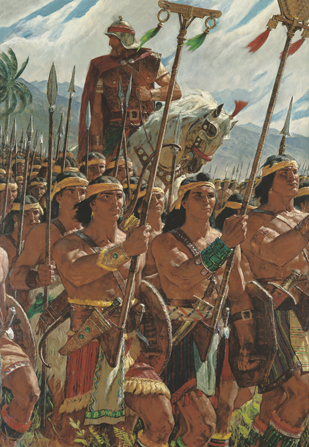
Conspicuously absent is any role of the horse in the many journeys recorded in the Book of Mormon. Nor does the Book of Mormon text indicate that horses or chariots play any role in the many Nephite wars (despite a popular classic Book of Mormon painting by Arnold Friburg depicting Helaman leading the 2000 stripling warriors while astride a battle-ready horse); this is in stark contrast to the Biblical account, in which the chariots of Egypt, Babylon, and the Philistines are feared super-weapons upon the plains of Israel.
Nor do we see a role for the horse in gallant cavalry charges that were the romantic warrior ideal in Joseph Smith's day. Nor is there any sign of the rapid war of maneuver and skirmish favored by the cavalry of the western nations. These are not the horses of the nineteenth century's practical realities or fanciful dreams.
There are societies in which the horse was vital, such as among the Hun warriors of Asia and Eastern Europe, for whom horses were a sign of wealth and status, and for whom they were essential for food, clothing, and war. Yet, there is no known horse bone from this period in the archaeological record.[2]
Wild horses were present in ancient America during the Pleistocene period (Ice Age), yet were not present at the time of the arrival of the Spaniards. Horses thrived once they were re-introduced by the Spaniards into the New World. The question then is: "Why were horses missing when the Spaniards arrived?" Is it possible that real horses lived in the Americas during Book of Mormon times? And if so, why does there seem to be no archaeological support?
At least a few non-Mormon scholars believe that real horses (of a stature smaller than modern horses) may have survived New World extinction. The late British anthropologist, M.F. Ashley Montague, a non-LDS scholar who taught at Harvard, suggested that the horse never became extinct in America. According to Montague, the size of post-Columbian horses provides evidence that the European horses bred with early American horses.[3]
Non-LDS Canadian researcher, Yuri Kuchinsky, also believes that there were pre-Columbian horses. Kuchinsky, however, believes that horses (smaller than our modern horses) were reintroduced into the west coast of the Americas about 2000 years ago from Asians who came by ship. Among Kuchinsky's evidences for pre-Columbian horses are:
Latter-day Saint scholars have also addressed this issue in various venues:
Unfortunately for this solution for the Book of Mormon, however, such theories are typically seen as fringe among mainstream scholars. Due to the dearth of archaeological support, most scholars continue to believe that horses became extinct at the end of the Pleistocene period.
We know, for example, that the Norsemen probably introduced horses, cows, sheep, goats, and pigs into the Eastern North America in the eleventh century A.D., yet these animals didn't spread throughout the continent and they left no archeological remains.[5] According to one non-LDS authority on ancient American, the Olmecs had domesticated dogs and turkeys but the damp acidic Mesoamerican soil would have destroyed any remains and any archaeological evidence of such animal domestication.[6]
Even in areas of the world where animals lived in abundance, we sometimes have problems finding archaeological remains. The textual evidence for lions in Israel, for example, suggests that lions were present in Israel from ancient times until at least the sixteenth century AD. Robert R. Bennett of the Neal A. Maxwell Institute Of Religious Scholarship notes,
A parallel example from the Bible is instructive. The biblical narrative mentions lions, yet it was not until very recently that the only other evidence for lions in Palestine was pictographic or literary. Before the announcement in a 1988 publication of two bone samples, there was no archaeological evidence to confirm the existence of lions in that region.6 Thus there is often a gap between what historical records such as the Book of Mormon claim existed and what the limited archaeological record may yield. In addition, archaeological excavations in Bible lands have been under way for decades longer and on a much larger scale than those in proposed Book of Mormon lands.[7]
In the Bible we read that Abraham had camels while in Egypt, yet archaeologists used to believe that this was an anachronism because camels were supposedly unknown in Egypt until Greek and Roman times. More recently, however, some researchers have shown that camels were used in Egypt from pre-historic times until the present day.
The fact is, however, that there does appear to be archaeological support that horses existed in pre-Columbian Mesoamerica. In 1957, for instance, at Mayapan (a site corresponding to Book of Mormon lands/times) horse remains were discovered at a depth considered to be pre-Columbian. Likewise, in southwest Yucatan, a non-Mormon archaeologist found what may likely be pre-Columbian horse remains in three caves. Excavations in a cave in the Mayan lowlands in 1978 also turned up horse remains.[8]
As an article for the Academy of Natural Science explains, such discoveries are typically "either dismissed or ignored by the European scientific community."[9] The problem may be one of pre-conceived paradigms. Dr. Sorenson recently related the story of a non-LDS archaeologist colleague who was digging at an archaeological dig in Tula and discovered a horse tooth. He took it to his supervisor--the chief archaeologist--who said, "Oh, that's a modern horse, throw it away" (which he did)--it was never dated.[10]
Dr. John Clark, director of the New World Archaeological Foundation has expressed similar concerns:
The problem is archaeologists get in the same hole that everybody else gets in. If you find a horse--if I'm digging a site and I find a horse bone--if I actually know enough to know that it is a horse bone, because that takes some expertise--my assumption would be that there's something wrong with my site. And so archaeologists who find a horse bone and say, "Ah! Somebody's screwing around with my archaeology." So we would never date it. Why am I going to throw away $600 to date the horse bone when I already know [that they're modern]? ...I think that hole's screwed up. If I dig a hole and I find plastic in the bottom, I'm not going to run the [radio]carbon, that's all there is to it. Because ...I don't want to waste the money.[11]
Joseph Smith obviously knew what a "horse" looked like. It stands to reason, therefore, that when Joseph said "horse" that this is exactly what he meant. If we consider, however, that Joseph was receiving revelation that simply conveyed what was written by the ancient author, we must consider the possibility that the ancient author was applying familiar terms to unfamiliar animals that were encountered in the New World. It is important to remember that the Book of Mormon itself is not an ancient text—it is a nineteenth-century translation of an ancient text. Modern readers need to have an understanding of what the ancient author was attempting to convey. Some of the things that seem "plain" to us are not so "plain" upon further investigation or once we understand the culture that produced the text.
For a detailed response, see: Loan shifting: "Horses" as deer and tapirs
See also Neal Rappleye's "Put Away Childish Things: Learning to read the Book of Mormon with Mature Historical Thought" from the 2017 FairMormon Conference. It details other loanshifts.
Europeans coming to the New World were not the only ones who struggled to label new animal species. The introduction of Old World animals into the New World, such as horses and cattle, also created labeling problems for Native Americans and terms for widely different species—such as deer, tapirs, and most commonly dogs—were loanshifted to horses by various native cultures throughout the Americas (see table 2)…
The Journal of Book of Mormon Studies: [12]
Publications from the late 1950s reported results from excavations by scientists working on the Yucatan Peninsula. Excavations at the site of Mayapan, which dates to a few centuries before the Spaniards arrived, yielded horse bones in four spots. (Two of the lots were from the surface, however, and might represent Spanish horses.) From another site, the Cenote (water hole) Ch'en Mul, came other traces, this time from a firm archaeological context. In the bottom stratum in a sequence of levels of unconsolidated earth almost two meters in thickness, two horse teeth were found. They were partially mineralized, indicating that they were definitely ancient and could not have come from any Spanish animal. The interesting thing is that Maya pottery was also found in the stratified soil where the teeth were located. [13]
Subsequent digging has expanded the evidence for an association of humans with horses. But the full story actually goes back to 1895, when American paleontologist Henry C. Mercer went to Yucatan hoping to find remains of Ice Age man. He visited 29 caves in the hill area—the Puuc—of the peninsula and tried stratigraphic excavation in 10 of them. But the results were confused, and he came away disillusioned. He did find horse bones in three caves (Actun Sayab, Actun Lara, and Chektalen). In terms of their visible characteristics, those bones should have been classified as from the Pleistocene American horse species, then called Equus occidentalis L. However, Mercer decided that since the remains were near the surface, they must actually be from the modern horse, Equus equus, that the Spaniards had brought with them to the New World, and so he reported them as such.[14] In 1947 Robert T. Hatt repeated Mercer's activities. He found within Actun Lara and one other cave more remains of the American horse (in his day it was called Equus conversidens), along with bones of other extinct animals. Hatt recommended that any future work concentrate on Loltun Cave, where abundant animal and cultural remains could be seen.[15]
It took until 1977 before that recommendation bore fruit. Two Mexican archaeologists carried out a project that included a complete survey of the complex system of subterranean cavities (made by underground water that had dissolved the subsurface limestone). They also did stratigraphic excavation in areas in the Lóltun complex not previously visited. The pits they excavated revealed a sequence of 16 layers, which they numbered from the surface downward. Bones of extinct animals (including mammoth) appear in the lowest layers.
Pottery and other cultural materials were found in levels VII and above. But in some of those artifact-bearing strata there were horse bones, even in level II. A radiocarbon date for the beginning of VII turned out to be around 1800 BC. The pottery fragments above that would place some portions in the range of at least 900–400 BC and possibly later. The report on this work concludes with the observation that "something went on here that is still difficult to explain." Some archaeologists have suggested that the horse bones were stirred upward from lower to higher levels by the action of tunneling rodents, but they admit that this explanation is not easy to accept. The statement has also been made that paleontologists will not be pleased at the idea that horses survived to such a late date as to be involved with civilized or near-civilized people whose remains are seen in the ceramic-using levels.[16] Surprisingly, the Mexican researchers show no awareness of the horse teeth discovered in 1957 by Carnegie Institution scientists Pollock and Ray. (Some uncomfortable scientific facts seem to need rediscovering time and time again.)
Paul S. Martin:
Admittedly, there is no theoretical reason why a herd of mastodons, horses, or ground sloths could not have survived in some small refuge until 8000 or even 4000 years ago. But in the past two decades, concordant stratiagraphic, palynological, archeological, and radiocarbon evidence to demonstrate beyond doubt the post-glacial survival of an extinct large mammal has been confined to extinct species of Bison…No evidence of similar quality has been mustered to show that mammoths, mastodons, or any of the other 29 genera of extinct large mammals of North America were alive 10,000 years ago. The coincidence in time between massive extinction and the first arrival of big game hunters cannot be ignored.[17]
Grayson:
In the first thorough review of radiocarbon dates associated with the extinct North American mammals, Martin (1958) concluded that the losses began in Mexico and Alaska during the Pleistocene and ended in Florida perhaps as recently as 2000 years ago (1958:405). Soon after, however, Hester (1960:58) concluded that the great majority of herd animals seemed to have been lost swiftly and together around 8,000 years ago even if some, like the mastodon, may have lingered on beyond then. Hester was thus the first to suggest, based on radiocarbon evidence, that a significant number, if not all, of the North American extinctions were synchronous. [18]
Bernardino de Sahagun:
Fodder was provided the deer—horses—which the Spaniards rode....The horses—they looked like deer—neighed and whinnied. They were all sweating; water fell from their bodies....[19]
John L. Sorenson: [20]
Excavations at the Post-Classic site of Mayapan in Yucatan in 1957 yielded remains of horses in four lots. Two of these specimens are from the surface and might have been remains of Spanish animals. Two other lots, however, were obtained from excavation in Cenote [water hole] Ch'en Mul "from the bottom stratum in a sequence of unconsolidated earth almost 2 meters in thickness." They were "considered to be pre-Columbian on the basis of depth of burial and degree of mineralization. Such mineralization was observed in no other bone or tooth in the collection although thousands were examined, some of which were found in close proximity to the horse teeth." Clayton E. Ray somewhat lamely suggests that the fossil teeth were of Pleistocene age and "could have been transported . . . as curios by the Mayans." [21]
John L. Sorenson:
A good example of the confusion is with the coatimundi (Nasua narica). Landa, the padre who favored us with a detailed description of Yucatan, wrote of the beast, "There is an animal which they call chic, wonderfully active, as large as a small dog, with a snout like a sucking pig. The Indian women raise them, and they leave nothing which they do not root over and turn upside down"...Another name, from the Aztecs, is pisote (Nahuatl pezotli), which means basically glutton. Yet pisote is sometimes applied also to the peccary or wild pig. In regard to the peccary, the Nahuatl terms quauhcoyametl and quahpizotl were developed after the conquest to distinguish the native species from the introduced Castilian pig, so by extension, the coati was sometimes termed quauhpezotli, tree-glutton, to distinguish it from the peccary, the ground-glutton.[22]
Wade E. Miller and Matthew Roper: [23]
Presently two distinct species of peccary live in Mesoamerica. These include the Collared Peccary (Pecari tajacu) and the White-lipped Peccary (Tayassu pecari), both of which can be found in the tropical regions near the Tuxtlas Mountains of the Yucatan. [24] The Jaredites as they presumably established settlements in Mesoamerica no doubt would have encountered them. They were hunted and eaten as early as Olmec times. Remains of these animals have been found associated with man for several thousands of years. There is a paleo-Indian carving of an extinct camel sacrum in the shape of a peccary. A Picture of this bone is shown by Evans. [25] The bone of this extinct camel came from deposits in central Mexico, and shows ancient interaction between this extinct animal and Pre-columbian natives. Remains of Pre-Columbian peccary have been found finds in Loltún Cave in the Yucatan [26] and in several other caves in the region associated with human artifacts. [27] There is no question that peccaries (“wild pigs”) and man shared this area since prehistoric times.

Wade E. Miller and Matthew Roper: [28]
Sheep were probably among the animals brought to America by the Jaredites, although they were not stated explicitly by name (Ether 6:4). They most likely are to be included in the term “flocks,” and are mentioned by name in Ether ( 9:18) several generations later. Sheep have been useful to man for many centuries and were probably man’s first domesticated animal [29] (along with the dog). They are useful for both food and clothing. In addition to Old World sheep, apparently brought to the New World by the Jaredites, there are sheep native to America. The most common type is the Mountain Sheep, Ovis canadensis. Their current geographic range extends south only to northern Mexico. However, their past range was more extensive, as was their habitat before human settlements expanded. [30] They are an animal that can be tamed or at least semi-domesticated. According to Geist , “It is hard to imagine a wild animal more readily tamed than mountain sheep.” [31] Sorenson noted the apparent recovery of sheep wool from a pre-Columbian burial site near Puebla (southeast of Mexico City). [32] Petroglyphs from Mexico and the southwestern United States show many prehistoric depictions of sheep. It appears certain that the association of sheep and man occurred in America before this animal was brought over beginning in 1493 with Columbus’ second voyage.
Bighorn sheep were native to North America at the time the the Jaredites arrived. The following is from Wikipedia:
The bighorn sheep (Ovis canadensis)[33] is a species of sheep in North America [34] named for its large horns. These horns can weigh up to 30 lb (14 kg), while the sheep themselves weigh up to 300 lb (140 kg). [35] Recent genetic testing indicates three distinct subspecies of Ovis canadensis, one of which is endangered: O. c. sierrae. Sheep originally crossed to North America over the Bering land bridge from Siberia: the population in North America peaked in the millions, and the bighorn sheep entered into the mythology of Native Americans. [36]
John L. Sorenson:
As with many other animals in the Book of Mormon, it is likely that these Book of Mormon terms are the product of reassigning familiar labels to unfamiliar items...The Miami Indians, for example, were unfamiliar with the buffalo and simply called them “wild cows.” Likewise the “explorer DeSoto called the buffalo simply vaca, cow. The Delaware Indians named the cow after the deer, and the Miami tribe labeled sheep, when they first saw them, ‘looks-like-a-cow’”[37]
Wade E. Miller and Matthew Roper: [38]
Bones of domesticated cattle (Bos taurus – see Figure 2) have been reported from different caves in the Yucatan Peninsula of Mexico.[39] In one instance these bones were found with those of an extinct horse, Equus conversidens. It is especially interesting that along with these cow and horse remains, human artifacts were found in association with them! The indication is that domesticated cattle and the horse coexisted with humans in pre-Columbian time. [40]

The current consensus is that ancient Americans did not keep herds of large animals for use as food. However, Pietro Martire d'Anghiera noted the following in 1912:
In all these regions they visited, the Spaniards noticed herds of deer similar to our herds of cattle. These deer bring forth and nourish their young in the houses of the natives. During the daytime they wander freely through the woods in search of their food, and in the evening they come back to their little ones, who have been cared for, allowing themselves to be shut up in the courtyards and even to be milked, when they have suckled their fawns. The only milk the natives know is that of the does, from which they make cheese.[41]
Martin Harris stated that he viewed the plates through "the eye of faith."
Author's sources: Rev. John A. Clark, Gleanings by the Way, (Philadelphia: W.J. and J.K. Simon; New York: Robert Carter, 1842), 256-7 off-site
John A. Clark, a former pastor who considered Joseph Smith a fraud and the Book of Mormon “an imposture,” states,
To know how much this testimony [of three witnesses] is worth I will state one fact. A gentleman in Palmyra, bred to the law, a professor of religion, and of undoubted veracity told me that on one occasion, he appealed to Harris and asked him directly,-”Did you see those plates?” Harris replied, he did. “Did you see the plates, and the engraving on them with your bodily eyes?” Harris replied, “Yes, I saw them with my eyes,-they were shown unto me by the power of God and not of man.” “But did you see them with your natural,-your bodily eyes, just as you see this pencil-case in my hand? Now say no or yes to this.” Harris replied,-”Why I did not see them as I do that pencil-case, yet I saw them with the eye of faith; I saw them just as distinctly as I see any thing around me,-though at the time they were covered over with a cloth.[42]
The source cited is “Martin Harris interviews with John A. Clark, 1827 & 1828,” Early Mormon Documents 2:270. However, rather than being an interview between Clark and Harris, as implied by the title of reference work using in the citation, Clark’s actual statement clearly says that he received his information from a “gentleman in Palmyra…a professor of religion,” who said that he had talked with Harris. This is not an interview between Clark and Harris.
Larry E. Morris notes that the “claim that ‘Harris told John A. Clark’ is not accurate. This is not secondhand testimony but thirdhand—’he said that he said that he said.’….As if that weren’t enough, Clark does not name his source—making it impossible to judge that person’s honesty or reliability. What we have is a thirdhand, anonymous account of what Martin Harris supposedly said.” (Larry E. Morris, FARMS Review, Vol. 15, Issue 1.)
The two elements that are mixed together in Clark's account are the following:
Note also that the date assigned to these comments places them prior to the publication of the Book of Mormon, yet Clark’s statement appears to include elements from both before and after Harris viewed the plates as a witness. Harris “saw them” with his eyes when he acted as one of the Three Witnesses, but he only saw them through the “eye of faith” when they were covered with a cloth prior to his being a witness. Clark’s third-hand hostile relation of another hostile source, makes no distinction between these events, and instead portrays Harris as contradicting himself.
When Martin Harris said that he had seen the angel and the plates with his "spiritual eyes" or with an "eye of faith" he may have simply been employing some scriptural language that he was familiar with. Such statements do not mean that the angel and the plates were imaginary, hallucinatory, or just an inner mental image—the earliest accounts of Martin Harris' testimony makes the literal nature of the experience unmistakable.
Rather than being hallucinatory or "merely" spiritual, Martin claimed that the plates and angel were seen by physical eyes that had been enhanced by the power of God to view more objects than a mortal could normally see (cf. D&C 76꞉12; D&C 67꞉10-13).
John H. Gilbert:
Martin was in the office when I finished setting up the testimony of the three witnesses,—(Harris—Cowdery and Whitmer—) I said to him,—"Martin, did you see those plates with your naked eyes?" Martin looked down for an instant, raised his eyes up, and said, "No, I saw them with a spir[i]tual eye."[43]
Pomeroy Tucker in his book Origin, Rise, and Progress of Mormonism (1867) also refers to Harris using the phrase "spiritual eye":
How to reconcile the act of Harris in signing his name to such a statement, in view of the character of honesty which had always been conceded to him, could never be easily explained. In reply to uncharitable suggestions of his neighbors, he used to practise a good deal of his characteristic jargon about "seeing with the spiritual eye," and the like. [44]
In 1875, Martin said:
"The Prophet Joseph Smith, and Oliver Cowdery and David Whitmer and myself, went into a little grove to pray to obtain a promise that we should behold it with our
eyesnatural eyes, that we could testify of it to the world (emphasis added)."[45]
Harris did not, then, see "spiritual eye" and "natural eye" as mutually exclusive categories. Both described something about the witness experience.
Why did Martin Harris use the particular phraseology that he did in describing his experience? Perhaps the answer lies in another passage found in the book of Ether 12꞉19.
And there were many whose faith was so exceedingly strong, even before Christ came, who could not be kept from within the veil, but truly saw with their eyes the things which they had beheld with an eye of faith, and they were glad.
Here it is noted that those people who have "exceedingly strong" faith can see things "within the veil." But even though they see things in the spiritual realm "with their eyes" it is described as beholding things with "an eye of faith."
Another possibility can be seen in the text of Moses 1꞉11. It reads:
But now mine own eyes have beheld God; but not my natural, but my spiritual eyes, for my natural eyes could not have beheld; for I should have withered and died in his presence; but his glory was upon me; and I beheld his face.
This dovetails nicely with the description of David Whitmer who "explained that he saw the plates, and with his natural eyes, but he had to be prepared for it—that he and the other witnesses were overshadowed by the power of God." [46]
Some wish to make it appear as though the statements made by Martin Harris about the Three Witnesses’ manifestation discount its reality. Doing so pulls Harris’ statements out of their proper context. This vital viewpoint can be regained by simply taking a look at several passages from the Book of Mormon and the Doctrine and Covenants—which all predate Martin’s public statements about the nature of his experience.
From these scriptural texts it is evident that:
Joseph Smith was an eyewitness to what Martin Harris said at the exact moment that the manifestation took place. He reported that Martin's words were: "Tis enough; mine eyes have beheld".[47] Another eyewitness, named Alma Jensen, saw Martin Harris point to his physical eyes while testifying that he had seen both the angel and the plates.[48]
Oliver Cowdery wrote a letter to a skeptical author in November 1829, and spoke for both himself and Harris on the question of whether there was some trickery or "juggling" at work:
The first edition of the Book of Mormon said that Joseph was "Author and proprietor," which in later editions was changed to "Translator."
FAIR is a non-profit organization dedicated to providing well-documented answers to criticisms of the doctrine, practice, and history of The Church of Jesus Christ of Latter-day Saints.
We are a volunteer organization. We invite you to give back.
Donate Now